

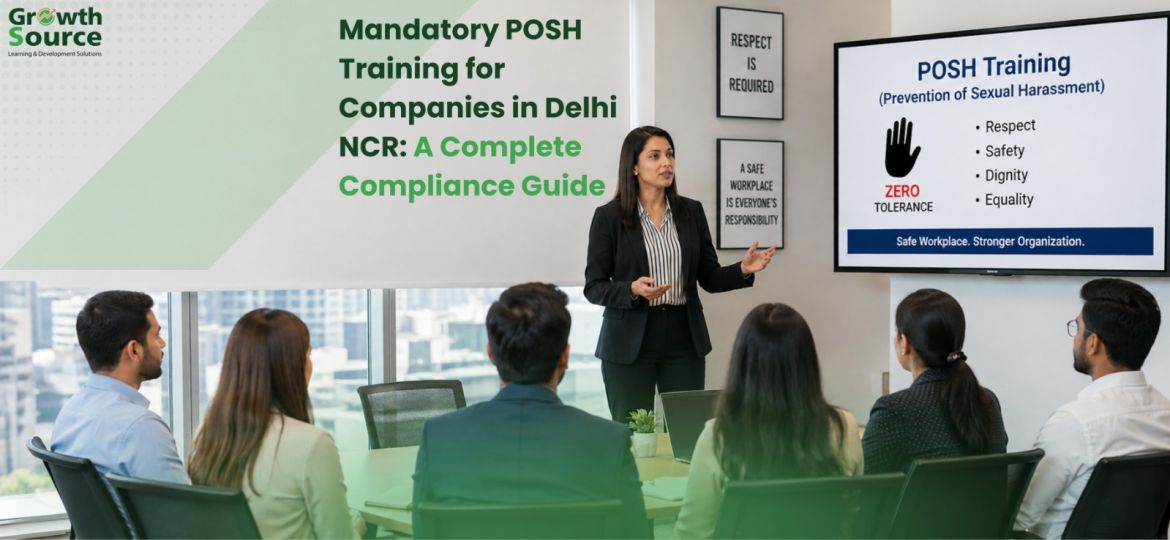
In today’s workplace environment, compliance is no longer optional—it’s foundational to building a safe, productive, and legally secure organization. For businesses operating in Delhi NCR, POSH training for Companies in Delhi NCR has become a critical requirement under Indian law. Companies that fail to comply not only risk legal penalties but also damage to reputation and employee trust.
At GrowthSource, we work closely with organizations to ensure they don’t just meet compliance requirements—but build workplaces where employees feel genuinely safe and respected.
Legal Framework: What Actually Gets Audited
POSH compliance is governed by the Sexual Harassment of Women at Workplace (Prevention, Prohibition and Redressal) Act, 2013, but most companies misunderstand what enforcement bodies actually evaluate.
Authorities don’t just check whether training happened—they assess:
- Training frequency vs employee count ratio
- Role-based coverage (employees vs IC vs leadership)
- Proof of comprehension (not just attendance)
- Case-handling readiness of IC members
- Documentation trail (training decks, recordings, assessments)
In Delhi NCR, inspections—especially for mid-to-large organizations—are increasingly documentation-heavy and evidence-driven.

Risk Mapping: Why Generic POSH Training Fails
Most organizations still rely on standardized POSH training for employees, assuming a one-size-fits-all module is enough to meet compliance. In reality, this approach creates a structural compliance gap—because workplace risk is not uniform, and neither is employee exposure.
Under the Sexual Harassment of Women at Workplace (Prevention, Prohibition and Redressal) Act, 2013, the definition of “workplace” is intentionally broad. However, generic training fails to translate this legal definition into real-world, role-specific scenarios, leaving organizations exposed.
The Core Problem: Lack of Contextual Relevance
Standard POSH sessions typically focus on definitions and examples that are:
- Office-centric
- Theoretical in nature
- Disconnected from actual workflows
This results in low situational awareness, especially in high-risk environments such as:
- Client-facing roles (sales, business development) where power dynamics and informal interactions are frequent
- Operational environments (manufacturing, warehouses) with contractor-driven ecosystems and weak reporting clarity
- Remote & hybrid teams where communication shifts to chats, calls, and unmonitored digital spaces
In such setups, employees often fail to recognize borderline misconduct, or worse, normalize it.
The Real Impact: Compliance That Doesn’t Hold Under Scrutiny
When training is not aligned with actual workplace dynamics, the consequences are serious:
- Misinterpretation of “workplace” scope
Employees may not understand that POSH applies beyond office premises—covering travel, offsite meetings, and virtual environments - Underreporting of incidents
Lack of clarity around jurisdiction and reporting channels discourages complaints - Inconsistent escalation pathways
Managers may respond informally instead of following mandated procedures - Weak legal defensibility
In case of litigation, organizations struggle to prove that employees were adequately trained for their specific risk environment
This directly impacts how effectively the Internal Committee can operate—and how defensible its decisions are.
What Works Instead: Risk-Mapped POSH Training Architecture
High-performing organizations are shifting toward risk-mapped training frameworks, where content is customized based on actual exposure points.
1. Industry-Specific Risk Calibration
Training modules are aligned with sector realities:
- Service vs manufacturing vs corporate environments
- Level of third-party/vendor interaction
- Gender diversity ratios and workforce structure
2. Interaction-Based Scenario Design
Instead of generic examples, training includes:
- Client interaction simulations
- Vendor/contractor scenarios
- Digital communication case studies
This improves decision-making clarity in real situations, not just theoretical understanding.
3. Hierarchy-Aligned Responsibility Mapping
Different roles receive different levels of training:
- Employees → Awareness & boundary recognition
- Managers → Escalation and response protocols
- Leadership → Accountability and risk ownership
This ensures that compliance is distributed, not centralized.
Internal Committee (IC): The Most Overlooked Liability
The Internal Committee (IC) is often treated as a compliance formality—but in reality, it functions as the primary legal defense mechanism of an organization under the Sexual Harassment of Women at Workplace (Prevention, Prohibition and Redressal) Act, 2013.
In any POSH-related dispute, the strength of your IC directly determines whether your organization can withstand legal scrutiny or face liability. Yet, across Delhi NCR, IC capability remains one of the most underdeveloped areas of compliance.
Critical Gaps Observed in Delhi NCR Organizations
Despite forming ICs on paper, many companies fail at the execution level. Common high-risk gaps include:
- Limited understanding of quasi-judicial authority
IC members often don’t realize they are required to function like an inquiry body—objectively evaluating evidence, maintaining neutrality, and ensuring procedural fairness - Weak or inconsistent documentation practices
Missing statements, incomplete records, or poorly structured findings can invalidate an entire inquiry - Violation of natural justice principles
Lack of fair hearing, bias, or failure to provide equal opportunity to both parties can render decisions legally challengeable - Non-adherence to statutory timelines
Delays in inquiry or reporting weaken both compliance standing and case credibility
These gaps don’t just reduce effectiveness—they directly increase legal exposure, even if the organization has conducted POSH training for employees.
What Advanced IC Training Must Actually Cover
To function as a legally sound body, IC members require specialized, scenario-driven training, not generic awareness sessions.
1. Evidence Evaluation Frameworks
- Differentiating between direct, circumstantial, and digital evidence
- Assessing credibility and consistency of statements
- Maintaining confidentiality while ensuring transparency
2. Structured Cross-Questioning Protocols
- Asking non-leading, unbiased questions
- Avoiding intimidation or influence
- Recording responses in a legally acceptable format
3. Legally Defensible Report Writing
- Structuring findings based on evidence, not assumptions
- Linking conclusions clearly to documented facts
- Ensuring language is neutral, precise, and audit-ready
4. Handling False or Malicious Complaints
- Distinguishing lack of evidence from malicious intent
- Applying provisions carefully to avoid misuse
- Protecting both complainant and respondent rights
Why This Matters: Compliance vs Legal Preparedness
There’s a critical difference between having an IC and having a competent IC.
If IC training is inadequate:
- Investigations become inconsistent
- Decisions become challengeable in court
- Organizations lose credibility in front of authorities
In contrast, a well-trained IC:
- Strengthens legal defensibility
- Ensures fair and timely resolution
- Builds employee trust in the system
Training Design That Meets Legal + Business Standards
High-impact POSH programs are no longer built as generic awareness sessions—they are engineered as multi-layered compliance systems that align legal requirements with day-to-day operational realities. Under the Sexual Harassment of Women at Workplace (Prevention, Prohibition and Redressal) Act, 2013, training must not only inform but also enable action, accountability, and defensibility.
To achieve this, leading organizations structure POSH training across three integrated layers:
1. Behavioral Layer (Employees): From Awareness to Action
This layer focuses on translating legal definitions into real-world behavioral clarity. Instead of abstract concepts, employees are trained through:
- Contextual scenarios across office settings, virtual interactions, and work-related travel
- Boundary-setting frameworks that help individuals identify and respond to inappropriate behavior early
- Bystander intervention models that empower colleagues to act responsibly rather than remain passive
The goal is to build situational judgment, ensuring employees can recognize and respond to misconduct in dynamic environments.
2. Procedural Layer (Managers): First Line of Response
Managers play a critical role as the first point of escalation, making their training essential for risk control. This layer emphasizes:
- Structured escalation protocols to ensure complaints are handled formally and promptly
- Documentation responsibility, including accurate recording of incidents and maintaining confidentiality
- Immediate response handling, balancing sensitivity with compliance requirements
Well-trained managers prevent informal handling of complaints—one of the most common causes of compliance failure.
3. Legal Layer (IC & HR): Ensuring Defensibility
At the core of POSH compliance lies the ability to withstand legal scrutiny, which depends on the competence of IC and HR teams. This layer includes:
- End-to-end inquiry lifecycle management, from complaint intake to final resolution
- Standardized evidence recording formats to ensure consistency and admissibility
- Compliance reporting protocols, aligned with statutory requirements and audit expectations
This ensures that every case handled is not only fair—but also legally defensible.
Training Coverage Benchmarks (Industry Practice – India)
| Metric | Recommended Benchmark | Risk if Not Met |
| Employee Training Coverage | 90–100% workforce annually | Exposure to compliance gaps |
| IC Member Training | 100% specialized training | Weak inquiry handling |
| Manager-Level Training | 100% people managers | Informal/mishandled complaints |
| Refresher Training Frequency | Every 6–12 months | Decline in awareness retention |
Strategic Business Impact of Strong POSH Systems
When implemented correctly, POSH training contributes to:
- Lower employee attrition in sensitive roles
- Higher trust in leadership
- Reduced legal exposure
- Stronger employer branding (critical in NCR hiring market)
Organizations investing in structured employee safety training programs see measurable improvements in workplace stability.
Final Perspective
For companies operating in Delhi NCR, POSH training in Delhi NCR is no longer about awareness sessions – it’s about building a legally defensible, scalable compliance system.
Organizations that treat POSH as a strategic function – not an HR formality—are better equipped to handle regulatory scrutiny, employee expectations, and brand reputation risks.
At GrowthSource, the focus is on designing compliance ecosystems that are not only legally aligned but also operationally practical—ensuring your organization is protected, prepared, and future-ready.
FAQs: POSH Training in Delhi NCR
- Is POSH training mandatory?
Yes, it’s required under the Sexual Harassment of Women at Workplace (Prevention, Prohibition and Redressal) Act, 2013. - How often should training happen?
At least once a year, with regular refresher sessions. - Who needs to attend?
All employees, including managers, leadership, and staff. - Do IC members need separate training?
Yes, they need specialized training for handling cases properly. - Is IC formation mandatory?
Yes, for companies with 10+ employees
